Tuesday, March 30, 2010

Today's Sixth Grade Lathe Demonstration


Mr. Wiemers
http://mrwiemersshop.com

Advisory


Mr. Wiemers
http://mrwiemersshop.com

Tuesday, December 1, 2009

Chess Board Production (part four)


Here are two bases, one walnut and one zebra wood. The chess boards are not yet attached since I am still considering how well the wood in the bases match the chess boards. I have also made some birch bases. There will be five total chess boards. The drawers need to be built, a bottom designed and some joints and trim inserted into the base for decorative purposes.

Mr. Wiemers
http://mrwiemersshop.com

Monday, November 23, 2009

. . . Just Work Hard

Teaching a class of students requires the ability to communicate and convey thoughts, ideas and information. But, if you have ever had a class succeed you will look back and realize that it also took a lot of work, sometimes a lot of physical effort, to get the job done. Yes, education involves innovative ideas, techniques and methodology (whatever that is?), but you will never escape the physical work and sheer time it takes to teach a class. In the end, after all the strategies and interventions, a good teacher will still have to go into the classroom alone and just work hard.

Mr. Wiemers
http://mrwiemersshop.com

Students Can Use Cell Phones in Class to Respond

Teachers can create questions or polls on this site for the students to respond to by sending a text message with their response. The results instantly appear on the computer screen.

http://textthemob.com/

Mr. Wiemers
http://mrwiemersshop.com

Friday, November 20, 2009

Chess Board Production (part three)


The birch and walnut chess board trimmed on the outside with Purple Heart which surrounds the Paduak and Yellow Heart. This gives the kids an inside look at the rain forest (literally, an inside look) and a different perspective. More of an industrial view than environmental view. As always, both are important and must be maintained. There is $$$ Green, and then, there is the other green. The two greens are never really separated. Both greens need each other to be the green they want to be. Try being green with the Green. Economically weak countries are always over run by an aggressor. Or, as many cultures in the past have found out, try being Green with out considering the green. These cultures have become extinct. Well, I wasn't planning on talking about "green," but instead wanted to point out the beautiful colors of the woods from around the globe. So, what about globalism?

Mr. Wiemers
http://mrwiemersshop.com
Thursday, November 19, 2009

Triangulation of Education in Cartoon Form

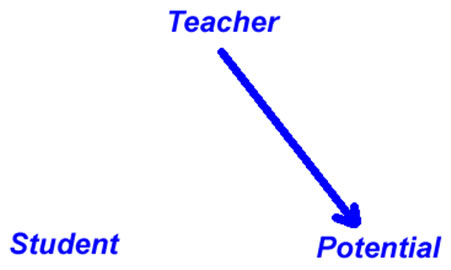
Some people would say the burden of education is on the teacher.
Others say the burden of learning is on the student.
Obviously, both the teacher and the student must put forth effort.

But, in this debate that surfaces every few years with new lingo and a new list of experts, we often forget that in the dynamics of learning there are three corners of triangular education. In one of these corners is the potential to learn. Some great teachers are great simply because they have found the right audience.


Mr. Wiemers
http://mrwiemersshop.com

Triangulation Educational Model

I am currently in the process of identifying and structuring the triangulation model of education. Key words and concepts are:

1. Teach (done by teacher)
2. Learn (done by student)
3. Potential (set by limits of realty)

(I will call it the TLP Triangulation Education Model. It can be referred to as TLP-TEM in professional journals. Now, if I can just find that perfect balance of complicating the obvious and over emphasizing the tangents then TLP-TEM might just sweep through the educational world. Wait, I need to get a job at a university and find some research money . . .)

Here is my article:

Any learning environment has unexplored growth potential that is never fully activated, but at the same time it is confined by the student's shadowy limitations set by reality. The three corners of the learning triangle are all powerful contributors to the extent of the educational process. They are:
  • teacher and the instructional process,
  • the student and their freewill (desire, motivation, interest, etc.), and
  • the natural biological and psychological ability of the student.
To ignore this triangular alignment (or, one of it's corners) is to entertain a vain educational view that strains the other corners beyond the point of logical expectations. For examples:
  1. To ignore the importance of the instructional quality will eventually flatten out the student's corner and demand the student do the illogical and teach themselves.
  2. To ignore the importance of the student's responsibility will eventually bring pressure on the teacher's corner which burdens it with an endless series of demands, expectations, strategies and staff inservices that can never replace the student's need to care about their own education.
  3. To ignore the natural ability of the student means the student and teacher will be thrust into an imaginary world that in theory (and, before qualifying statements are unleashed) claims that all students can learn everything.
In the correctly balanced model all three corners must be acknowledged and responsibility assigned and expected. An equilateral triangle must be maintained. Foolish educational theories laced with post-modern values will not only be frustrating for the student, the teacher, the school and the community, but they will prove to be educationally fatal.

Each of the corners has ability to improve its contribution to the educational process. Teacher's can always improve. Always. They can find new strategies, become more acquainted with their subject matter, use different mediums to communicate, bring alongside themselves specialist in techniques or knowledge, ect. Students can find motivation or desire by realizing the importance of education, the satisfaction of education, or simply, the expectation of education. Although, potential, in this theory is a set variable, the opportunity of expansion (therapy, interaction, etc.) up to that set variable from the current available potential is possible.

Mr. Wiemers
http://mrwiemersshop.com

Rejected Delivery: Not Everyone Gets an A+ in Shop

We have been receiving lumber (Appalachian Oak #1 Common surfaced to 25/64 straight line ripped one side) for nine years. We receive about 2,000 board feet each year and have turned it into over 1,000 tables among many other projects. Today a delivery of 700 board feet came and the students started to carry it in like students have done for years. And I, like always, began to stack the wood and evaluate the quality of my purchase. The first two boards were less than acceptable, but there is a truck load more being carried in. But, by the fifth and sixth boards I began to wonder about the entire load. I had the students stop bringing in the lumber and went to talk to the driver. After looking through a good part of the load on the truck I finally did what I had threatened to do for years. I sent the entire load of oak back as unacceptable and called my rep at the company. I apologized but the rep agreed we had been getting the same order for nine years and this load was not the quality that we needed.

It was a real life experience for the students to see their teacher reject the work of a delivery man and the lumber company. I guess after all is said and done, not everyone gets an A+ in shop.

Mr. Wiemers
http://mrwiemersshop.com
Wednesday, November 18, 2009

Chess Board Production (part two)


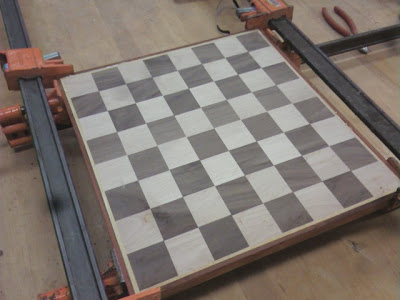
The walnut/birch chess board with initial trim of Yellow Heart from Brazil and Paduak from West Africa.


The chess board clamping in clamps attaching the Paduak wood trim.


Mr. Wiemers
http://mrwiemersshop.com

Monday, November 16, 2009

Chess Board Production

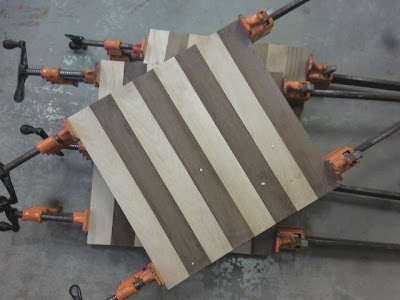
Two inch strips of walnut and birch.


Glue together.


Cut across grain. Flip every other one over.


Glue and clamp to make the chess board.


Chess pieces turned on a CNC lathe in the shop.


Trimming the chess board with 18" strips of Yellow Heart wood from Brazil


Cutting strips of Paduak from West Africa to trim the chess board

Thursday, October 29, 2009


Mr. Wiemers
http://mrwiemersshop.com

Monday, October 19, 2009

Madison Wins State CC Championship


Mr. Wiemers
http://mrwiemersshop.com

Thursday, October 15, 2009

Ten Tips for Writing a Blog

These tips taken from Mr. McClung's post at this link. I found this very useful for a variety of reasons. Mr. McClung is doing this as a class project. I will use this for my own students who are blogging, but also personally and at school.

1. Make your opinion known
People like blogs, they like blogs because they are written by people and not corporations. People want to know what people think, crazy as it sounds they want to know what you think. Tell them exactly what you think using the least amount of words possible.

2. Link like crazy.
Support your post with links to other web pages that are contextual to your post.

3. Write Less
Give the maximum amount of information with the least amount of words. Time is finite and people are infinitely busy. Blast your knowledge into the reader at the speed of sound.

4. 250 is enough
A long post is easier to forget and harder to get into. A short post is the opposite.

5. Make Headlines snappy
Contain your whole argument in your headline. Check out National newspapers to see how they do it.

6. Include bullet point lists
We all love lists, it structures the info in an easily digestible format.

7. Make your posts easy to scan
Every few paragraphs insert a sub heading. Make sentences and headlines short and to the point.

8. Be consistent with your style
People like to know what to expect, once you have settled on a style for your audience stick to it.

9. Litter the post with Keywords.
Think about what keywords people would use to search for your post and include them in the body text and headers. make sure the keyword placement is natural and does not seem out of place.

10. Edit your post
Good writing is in the editing. Before you hit the submit button, re-read your post and cut out the stuff that you don’t need.

Mr. Wiemers
http://mrwiemersshop.com

Wednesday, October 14, 2009

Mr. Wiemers' Mad BB Skills


Mr. Wiemers
http://mrwiemersshop.com

Tuesday, October 13, 2009

Luke's Half-Pipe


When Luke came into the shop as a sixth grader he asked several times if he could ever build a small half-pipe for his tech-decks. Today Luke and I put one together quick for him before his seventh grade year comes to a close this week.


Mr. Wiemers
http://mrwiemersshop.com